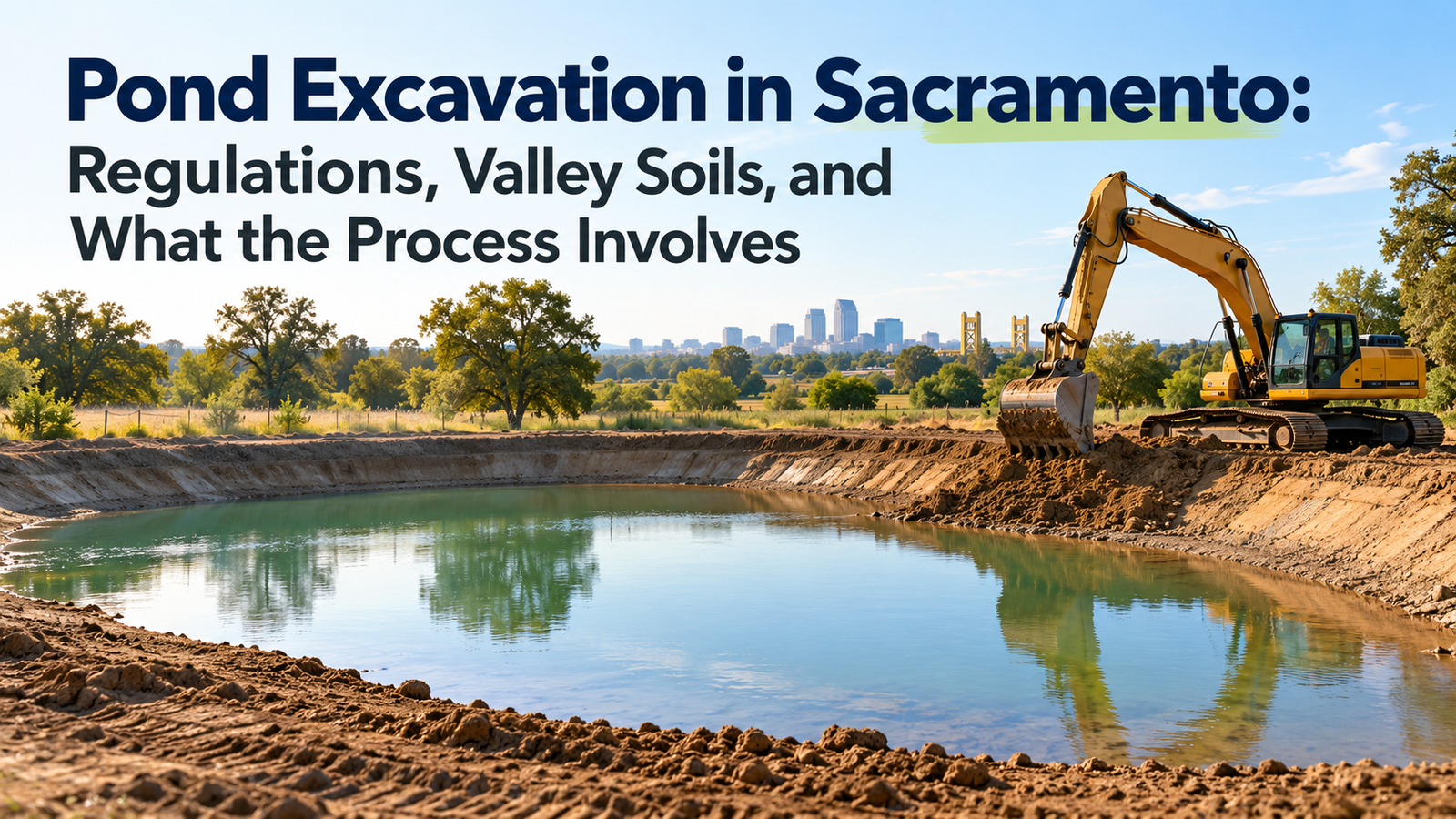
Pond excavation in the Sacramento area creates water features for agricultural irrigation, livestock watering, stormwater retention, aquaculture, wildlife habitat, and landscape aesthetics on residential and commercial properties. The Sacramento Valley’s rich agricultural tradition means that farm ponds and irrigation reservoirs have been a part of the regional landscape for more than a century. More recently, regulatory stormwater management requirements have made constructed detention and retention ponds standard elements of commercial and residential development approvals throughout Sacramento County.
What distinguishes Pond Excavation Sacramento from the same work in other regions is the combination of the valley’s clay-rich soils which have unique implications for pond sealing and embankment stability the network of state and federal regulations governing earthwork near waterways and wetlands, and the specific hydrology of the Sacramento Valley, where water table elevations, seasonal flooding, and canal systems interact with excavated ponds in ways that affect design and construction.
Types of Ponds Constructed in the Sacramento Area
Agricultural ponds are excavated reservoirs used for irrigation storage, tailwater recovery, and livestock water supply. These are typically designed by agricultural engineers and must comply with Natural Resources Conservation Service (NRCS) standards for embankment design, spillway sizing, and seepage control. NRCS provides technical and financial assistance for farm pond construction through the Environmental Quality Incentives Program (EQIP), which has helped fund thousands of agricultural water storage projects in the Sacramento Valley.
Stormwater detention and retention basins are constructed as part of development projects to manage post-development runoff rates and volumes. Detention basins hold water temporarily and release it slowly; retention basins hold water permanently and reduce runoff by allowing infiltration or evaporation. These facilities are designed to meet Sacramento County’s stormwater management standards and are sized based on hydrologic analysis of the contributing watershed area and the design storm event.
Decorative and wildlife ponds on residential and commercial properties serve landscape and habitat purposes. These range from small backyard water features to multi-acre constructed wetlands on larger properties. Decorative ponds in residential settings are generally exempt from the regulatory requirements that apply to agricultural and stormwater ponds, but larger wildlife ponds near waterways or wetlands may require permits from the California Department of Fish and Wildlife and the Army Corps of Engineers.
Sacramento Valley Soils and Pond Sealing
The Sacramento Valley’s Vertisol clays have natural pond sealing characteristics. When wetted, these expansive clays close their desiccation cracks and form a relatively impermeable layer that retains water effectively. Many agricultural ponds in the Sacramento area rely entirely on the natural clay content of the excavated soil to seal the pond bottom and sides without additional liner materials.
However, some Sacramento soils have higher sand or silt content that reduces natural sealing effectiveness. In these cases, pond sealing options include bentonite treatment mixing sodium bentonite clay into the pond bottom soil to increase clay content and reduce permeability compacted clay liner installation using imported clay material, or synthetic geomembrane liners for situations where maximum sealing performance is required.
Soil testing before pond design determines whether natural sealing is sufficient. Particle size analysis and permeability testing of the excavated soil provide the data needed to specify the appropriate sealing approach. For agricultural ponds where some seepage is acceptable, natural soil sealing may be adequate. For stormwater ponds where specific seepage rates must be met, engineered liner systems provide the necessary performance guarantee.
Hydrology and Water Table Considerations in Sacramento
The Sacramento Valley has a high water table in many areas, elevated by the region’s history of irrigation and the proximity to the Sacramento and American rivers. In some locations, the seasonal water table rises to within a few feet of the surface during winter and spring. This condition affects pond excavation in several ways.
Shallow excavations for decorative or small agricultural ponds may encounter groundwater before reaching the design pond bottom depth. Dewatering during excavation maintains dry working conditions for equipment and allows the pond bottom to be prepared properly. After construction, pond water levels are partially maintained by groundwater inflow in high water table areas, which can be an advantage for ponds intended to maintain permanent water.
For stormwater ponds, high water tables can interfere with infiltration functions if the seasonal water table intersects with the pond bottom. A clearance between the design high water surface of the pond and the seasonal high water table is typically required by Sacramento County stormwater management standards to ensure that the pond operates as intended and does not become a groundwater conduit.
Regulatory Requirements for Pond Excavation in Sacramento
Pond excavation near waterways, wetlands, or other waters of the United States requires a Section 404 permit from the Army Corps of Engineers and a Section 401 Water Quality Certification from the California State Water Resources Control Board. These permits evaluate whether the proposed pond construction affects wetlands or other jurisdictional waters. Even ponds that are not in or adjacent to waterways may require permit review if the excavation could affect seasonal wetlands, vernal pools, or ephemeral drainages present on the site.
The California Department of Fish and Wildlife (CDFW) may require a Streambed Alteration Agreement under Fish and Game Code Section 1602 for pond excavation projects that alter or modify streambeds, whether perennial, intermittent, or ephemeral. Sacramento County is within CDFW Region 2, and the Streambed Alteration Program reviews projects that involve work within a stream’s channel, bed, bank, or riparian zone.
For ponds constructed as part of development projects, the environmental review under the California Environmental Quality Act (CEQA) evaluates biological resource impacts including wetlands, special-status species, and water quality. The CEQA process determines whether mitigation measures are required typically habitat restoration planting, construction windows that avoid nesting bird season, and biological monitoring during excavation.
Excavation Equipment and Construction Sequence for Sacramento Ponds
Pond excavation uses standard earthmoving equipment sized to the pond volume. Small decorative ponds may be excavated with a compact excavator. Agricultural ponds and stormwater basins require larger equipment standard hydraulic excavators in the 20-to-50-ton class, scrapers, and dump trucks for material haul-off.
The construction sequence begins with stripping topsoil from the pond footprint and stockpiling it for reuse in embankment or surrounding landscape areas. Excavation then proceeds to design depth, with material hauled to embankment fill areas or off-site as needed. Embankment construction uses compacted cut material or imported clay fill, placed in lifts and compacted to specified density. Spillway structures typically concrete drop inlets, pipe spillways, or earthen emergency spillways are installed as the embankment is built up.
Pond bottom and interior slope shaping is the final step in excavation, with laser-guided grading equipment achieving the smooth, uniformly sloped surfaces specified in the design. Bottom slopes drain the pond to the outlet structure for maintenance dewatering. Interior slopes are typically 3:1 or flatter for safety and stability in Sacramento’s expansive clay soils.
Frequently Asked Questions: Pond Excavation in Sacramento
Do I need permits to excavate a pond on my Sacramento property?
Depends on the pond’s location and size. Ponds near waterways, wetlands, or jurisdictional waters require Army Corps Section 404 permits and CDFW Streambed Alteration Agreements. Stormwater ponds as part of development require Sacramento County stormwater management approvals. Small decorative ponds on upland parcels away from regulated features may not require state or federal permits.
How do Sacramento’s clay soils affect pond design?
Valley Vertisol clays provide natural pond sealing when properly wetted and prepared. Sandy or silty soils require bentonite amendment or engineered liner systems. Soil testing before design determines the appropriate sealing approach.
What is the water table like in Sacramento and how does it affect pond construction?
The water table is relatively shallow in many parts of the Sacramento Valley, elevated by irrigation history and river proximity. High water tables may require dewatering during excavation and affect the design of stormwater ponds that rely on infiltration.
What equipment is used for agricultural pond excavation in Sacramento?
Hydraulic excavators, scrapers, and dump trucks for large-volume earthmoving. Laser-guided grade control ensures the accurate bottom slopes and embankment shapes required by NRCS engineering standards.
What is a CDFW Streambed Alteration Agreement and when is it needed?
An agreement required under Fish and Game Code Section 1602 when proposed work alters or modifies a streambed including ephemeral drainages. Projects near any watercourse, however intermittent, should evaluate whether a Streambed Alteration Agreement is required before excavation begins.
Pond excavation in Sacramento combines standard earthmoving technique with the specific conditions of the Central Valley: clay soils that seal naturally but challenge dry-weather excavation, high water tables in many areas, and a regulatory framework that reflects California’s comprehensive protection of water resources and biological communities. Professional pond excavators in the Sacramento area bring both equipment capability and regulatory knowledge to every project.